More than two decades after his tragic cocaine overdose, the late Len Bias still leaves more questions than answers. When Bias dropped dead two days after the 1986 NBA Draft, he forever altered our perception of casual drug use and became the tipping point of America's drug crisis in the mid-80's. Future generations continue to face the harsh punishment of drug policies that were influenced by the public outcry after his heartbreaking death. Instead of becoming an NBA star, he became a one-man deterrent, the athlete who reminded everyone just how dangerous drug use can be. Amazingly, questions still linger about his death nearly a quarter-century later. How good could he have been in the pro ranks? Has he become underrated or overrated as the years pass? How could a University of Maryland superstar and Boston Celtics lottery pick be derailed by a cocaine binge? Was Bias a one-time user as we were led to believe, or was there a pattern of recreational use that led to his fatal last night? Did he fall in with the wrong crowd? In the most ambitious, comprehensive and uncompromising account of Bias’ life and death ever captured on film, up-and-coming director Kirk Fraser utilizes dozens of interviews with Bias’ closest teammates, friends and family in an effort to determine exactly what happened on that fateful night. Maybe it wasn't as much of a fluke as we thought.
As Michael Jordan's retirement saw the Chicago Bulls quickly fade as an NBA title threat, the Heat beat out the Indiana Pacers and Orlando Magic to reach the top of the Eastern Conference. The Knicks could only get through the 50-game season with a 27-23 record, barely qualifying for the playoffs as a #8 seed. This put the odds squarely in the Heat's favor, as only once in NBA history had a #8 seed defeated a #1 seed in the first round. However, the Knicks attempted to defy expectations and took two of the first three games, including a 20-point blowout in game 1 and a 24-point victory in game 3, with a chance to win the series at home in game four. The Knicks held an eight-point lead in that game until the Heat came charging back to win 87-72 and set up a decisive game 5.
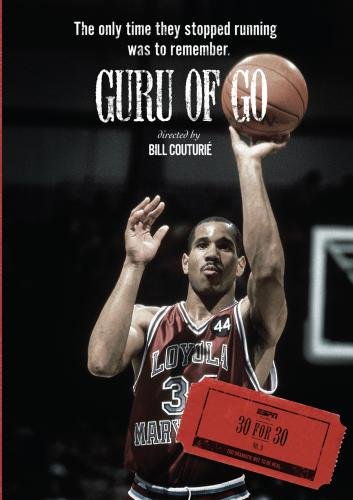
Storyline By the mid-1980s Paul Westhead had worn out his welcome in the NBA. The best offer he could find came from an obscure small college with little history of basketball. In the same city where he had won an NBA championship with Magic and Kareem, Westhead was determined to perfect his non-stop run-and-gun offensive system at Loyola Marymount. His shoot-first offense appeared doomed to fail until Hank Gathers and Bo Kimble, two talented players from Westhead's hometown of Philadelphia, arrived gift-wrapped at his doorstep. With Gathers and Kimble leading a record scoring charge, Westhead's system suddenly dazzled the world of college basketball and turned conventional thinking on its head. But then, early in the 1989-90 season, Gathers collapsed during a game and was diagnosed with an abnormal heartbeat. Determined to play, Gathers returned three games later, but less than three months later, he tragically died on the court.
Pete Bell (Nolte), a college basketball coach for the fictional Western University Dolphins, is under a lot of pressure. His team isn't winning as often as it once did and his successful program needs to attract new star players and fast!
Blue Chips is a 1994 drama film about basketball, directed by William Friedkin, written by Ron Shelton and starring Nick Nolte as a college coach and real-life basketball stars Shaquille O'Neal and Anfernee "Penny" Hardaway as talented finds. It features cameos from noted basketball figures Bob Knight, Rick Pitino, Bob Cousy, Larry Bird, Jerry Tarkanian, Allan Houston, Dick Vitale and Jim Boeheim, as well as Oscar-winning actor Louis Gossett, Jr.
Cast:
Nick Nolte as Coach Pete Bell Mary McDonnell as Jenny Bell J. T. Walsh as Happy Ed O'Neill as Ed Alfre Woodard as Lavada McRae Bob Cousy as Vic Matt Nover as Ricky Roe Shaquille O'Neal as Neon Boudeaux Anfernee "Penny" Hardaway as Butch McRae
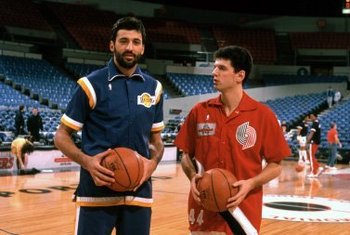
Drazen Petrovic and Vlade Divac were two friends who grew up together sharing the common bond of basketball. Together, they lifted the Yugoslavian National team to unimaginable heights. After conquering Europe, they both went to America where they became the first two foreign players to attain NBA stardom. But with the fall of the Soviet Union on Christmas Day 1991, Yugoslavia split up. A war broke out between Petrovic's Croatia and Divac's Serbia. Long buried ethnic tensions surfaced. And these two men, once brothers, were now on opposite sides of a deadly civil war. As Petrovic and Divac continued to face each other on the basketball courts of the NBA, no words passed between the two. Then, on the fateful night of June 7, 1993, Drazen Petrovic was killed in an auto accident. "Once Brothers" will tell the gripping tale of these two men, how circumstances beyond their control tore apart their friendship, and whether Divac has ever come to terms with the death of a friend before they had a chance to reconcile.
LOVE AND BASKETBALL is the powerful story of two next-door neighbors in Los Angeles who grow up loving basketball and, eventually, each other. Monica (Sanaa Lathan) and Quincy (Omar Epps) have wanted to be basketball stars since they were kids. Monica has had to work hard to establish herself as a presence, while Quincy was born with natural star potential. As the two struggle to reach their goals of playing professionally, they must also deal with their feelings for each other.
Lisa Deshaun Leslie-Lockwood (born July 7, 1972, in Gardena, California) is a former American professional women's basketball player in the WNBA. She is a three-time WNBA MVP and a four-time Olympic gold medal winner. The number seven pick in the 1997 inaugural WNBA draft, she followed a superb career at the University of Southern California with seven WNBA All-Star appearances and two WNBA championships over the course of eleven seasons with the Los Angeles Sparks, before retiring in 2009.[1] Leslie, a 6'5" center, is the first player to dunk in a WNBA game. She was considered a pioneer and cornerstone of the league during her WNBA career.
Hamilton played college basketball at the University of Connecticut from 1996–99. He was named the 1999 NCAA Tournament's Most Outstanding Player after UConn's run to that year's national title. Hamilton was the 7th pick overall in the 1999 NBA draft and played for the Washington Wizards for his first three seasons as a professional. Hamilton, Hubert Davis and Bobby Simmons were then traded to the Detroit Pistons for Jerry Stackhouse, Brian Cardinal and Ratko Varda. Since the trade, Hamilton has become one of the NBA's top shooting guards, and helped the Pistons win the NBA Championship in 2004. Also, Hamilton was the leading scorer on the team. After fracturing his nose three times in the 2003–2004 season, Hamilton began wearing a protective mask. He has continued to wear the mask since it has become a symbol of strength. Hamilton says, "It's like my Superman cape."[1]
Candace Parker,est née le 19 avril 1986 à St. Louis dans le Missouri, est une joueuse de basket-ball américaine, évoluant au poste d'ailière.
Candace Nicole Parker (born April 19, 1986 in St. Louis, Missouri) is an All-American basketball player for the WNBA's Los Angeles Sparks and is also the younger sister of NBA player Anthony Parker. She was drafted to the team from Tennessee in 2008. She may be best known for being the first woman to dunk in an NCAA tournament game and the first woman to dunk twice in a college game —she set both milestones as a redshirt freshman on March 19, 2006. She also became only the second player to dunk in a WNBA game on June 22, 2008.[1][2][3] A versatile player, she is mainly a forward, but was listed on Tennessee's roster as a forward, center, and guard.[4] She was a starter on the Lady Vols basketball team, winners of the 2007 and 2008 NCAA championships. Candace won the 2009 Nickelodeon Kids' Choice award as the favorite female athlete in the sports category.
Awards and Honors Big East Player of the Year (2003, 2004) Wade Trophy Winner (2003) Naismith Award (2003, 2004) Nancy Lieberman Award (2003, 2004) NCAA National Championship (2002,2003,2004) NCAA Tournament MVP (2003, 2004) WNBA Rookie of the Year (2004) All-WNBA First Team (2004, 2006, 2007, 2008, 2009) All-WNBA Second Team (2005) WNBA All-Star (2005, 2006, 2007, 2009) WNBA Championship (2007, 2009) WNBA Most Valuable Player (2009) WNBA Finals MVP (2009)
The Seattle SuperSonics (also commonly referred to as the Sonics) were an American professional basketball team based in Seattle, Washington that played in the Pacific and Northwest Divisions of the National Basketball Association (NBA) from 1967 until 2008. Following the 2007–08 season, the team relocated to Oklahoma City, and now plays as the Oklahoma City Thunder. The SuperSonics nickname, logo, and color scheme will be made available to any subsequent NBA team in Seattle.[1] According to the team's Oklahoma-based owners, the Sonics' franchise history will be "shared" between the Thunder and any future Seattle club.[2] The SuperSonics won the NBA Championship in 1979, and are one of just two teams out of the six major-league men's professional sports franchises that have existed in Seattle (the Sonics, Mariners, Pilots, Seahawks, Sounders, and Metropolitans, winners of the 1917 Stanley Cup) to have won a championship. Sam Schulman owned the team from its 1967 inception until 1983. It was also owned by Barry Ackerley (1983–2001), and the Basketball Club of Seattle, headed by Starbucks chairman Howard Schultz (2001–2006). In 2006, the SuperSonics were purchased by Oklahoma City businessman Clay Bennett. After failing to find public funding to construct a new arena in the Seattle area, the SuperSonics moved to Oklahoma City before the 2008–09 season, following a $45 million settlement with the city of Seattle to pay off the team's existing lease at KeyArena in advance of its 2010 expiration.
This documentary follows two inner-city Chicago residents, Arthur Agee and William Gates, as they follow their dreams of becoming basketball superstars. Beginning at the start of their high school years, and ending almost 5 years later, as they start college, we watch the boys mature into men, still retaining their "Hoop Dreams". Both are recruited into the same elite high school as their idol, former Detroit Piston superstar Isaiah Thomas. Only one survives the first year; the other must return to a high school closer to his home. Along the way, there is much tragedy, some joy, a great wealth of information about inner city life, and the suspense of not knowing what will occur next. This is not a "by-the-numbers" film.
Coach Carter is a 2005 film from Paramount Pictures, directed by Thomas Carter. It is based on a true story, in which Richmond High School basketball coach Ken Carter made headlines in 1999 for benching his MVP and undefeated team due to poor academic results. The screenplay was co-written by Mark Schwahn, who created the TV series One Tree Hill. The movie also recycles a handful of plot-lines from another TV series, The White Shadow, which director Thomas Carter co-starred in.
HOW REAL IS THE REEL COACH CARTER by ESPN:
In the opening credits of "Coach Carter," the audience is told that the movie is "Inspired by the life of Ken Carter."
Is this just another Hollywood way of saying, "we're telling the truth, sort of, when it serves our purposes." Or is this the true story of the Richmond (Ca.) High School Oilers 1998-99 season?
Ken Carter, in a news conference at Richmond H.S. just a few weeks ago, gave his take. ""I believe in this movie," he said. "I was there every day of the shoot and worked with the writers and producers."
That should make things accurate, for sure. But Carter added, in what might be considered a cautionary note, "It's a combination of 'Rudy,' 'Stand and Deliver,' 'Lean on me,' 'Hoosiers' and 'Seabiscuit.'"
Uh oh. So, how real is the reel? You decide.
CARTER, CARTER, AND CARTER
Sam Jackson plays Coach Carter in his first sports-themed movie. In Reel Life: "Coach Carter" is directed by Thomas Carter. In Real Life: No relation. But a huge connection to the inner-city-feel-good-hoops-coach-as-savior-on-screen subgenre. Thomas Carter played James Hayward, a main character in "The White Shadow," the classic drama about high school hoops in South Central L.A. That show, many viewers agree, jumped the shark when Hayward graduated (jumptheshark.com) at the end of the second season. But it was about time. Carter was 24 when his character got his high school diploma.
In Reel Life: Ken Carter (Samuel L. Jackson) is introduced to the team. The outgoing coach describes himself as a former Richmond player who still holds the school's scoring, assists, and steals records, was two-sport All American, and got a basketball scholarship to George Mason University. In Real Life: Carter was a very good high school player, being named All League his senior year (1976-77) after averaging 23.3 points per game. Carter told Rush Limbaugh in Feb. 1999 that he played basketball, and made no mention of other sports.There's no evidence that he was an All-American in any sport, although it's possible.
Carter didn't attend George Mason University. He went to San Francisco State, then Contra Costa College, and finally, for one-and-a-half years, George Fox University, where he did play basketball.
In Reel Life: Carter says to a player, "As of now, you are 'sir.' Sir is a term of respect." Throughout the film, he calls everyone "sir" and "ma'am." In Real Life: That's right on. That's what he did. And does. A conversational snippet, from "The Limbgaugh Letter" of Feb. 1999:
Rush: Hey, Coach! Carter: Yes, Sir. Rush: Thank you for carving a little bit time out for us here. I know you've got to be just jammed with all these requests. So we appreciate it. Carter: Sir, like I say, if it's for our kids, everything is worth it Rush: Well, that's an interesting philosophy. "If it's for the kids, everything is worth it." What do you do? Is it correct what I've read, that you're only a part-time coach? Carter: Yes, Sir. I'm self employed. Rush: Doing what? Carter: My family owns a sporting goods store, Sir. Rush: So you've had a lifelong interest in sports? Carter: Yes, Sir. Rush: Participated in it yourself? Carter: Yes, Sir.
In Reel Life: Carter wears a sleek suit and tie at all times. In Real Life: True. "That's something drawn directly from Coach Carter," Thomas Carter told Film Journal. "The real Ken Carter has the snappiest ties in Hollywood, snappier than Sam's in the film."
In Reel Life: Carter's son, Damien (Robert Ri'chard), attends St. Francis, and is a player there, but he doesn't get into a preseason exhibition against Richmond, because, his father explains, he's a freshman. In Real Life: Damien was a sophomore during the 1998-99 season depicted in the film. He had started for Richmond's varsity as a freshman.
BASKETBALL
In reel life: Never cross Samuel L. Jackson. In Reel Life: When Carter accepts the coaching position, he's told he'll be paid a $1,500 stipend for the season. In Real Life: That's what he was paid.
In Reel Life: Apparently, Richmond has only a varsity squad. In Real Life: Richmond had varsity, JV, and freshman teams, 45 players in all.
In Reel Life: As the movie begins, Richmond is being crushed in a preseason game against St. Francis, led by Tyrone Crane (Sidney Faison). Crane, interviewed after the game, is billed as "The next Lebron James." In Real Life: That's one kick-butt local prep TV reporter. During the 1998-99 basketball season LeBron was in 8th grade, and hadn't received much national media attention -- although he was already considered a phenom. However, for any reporter to be describing any high school player as "the next Lebron" in 1999 would be & unlikely.
In Reel Life: Carter names plays and defensive schemes after his sisters. The man-to-man pressure defense, for example, is named "Diane." In Real Life: Carter had seven sisters and one brother, and did name plays after them. "When we go, 'Cookie!' Cookie is our toughest defense," he told the Contra Costa Times in 2001. "That's my sister, who's the toughest and who is the loudest."
In Reel Life: Richmond is invited to compete in the Bay Hill Holiday Tournament. They make it to the finals. Down by 6 with 1:20 to play, Damien makes a three-pointer, dishes an assist, steals the ball and makes another three, then drives for the winning bucket at the buzzer, to give the Oilers a 79-78 win. In Real Life: Carter's son was, indeed, an excellent player, good enough to be named honorable mention All-Conference as a frosh. By the time he graduated, he had surpassed his father as Richmond's all-time leading scorer and, according to coachcarter.com (coachcarter.com), was "California Boys Basketball Leading Scorer."
In Reel Life: In Richmond's first game after the lockout, they beat Arlington, 82-68. In Real Life: The Oilers beat St. Elizabeth High School, 61-51, their first game back.
In Reel Life: After the preseason game against St. Francis, Richmond doesn't lose another game, and there's no mention of any losses. In Real Life: Richmond finished the season with a 19-5 record, and did lose steam, losing two in a row shortly after returning.
In Real Life: Richmond faces top-ranked St. Francis in the first round of the state tournament. The Oilers play a great game, but lose 70-69 on a St. Francis buzzer-beater. In Real Life: Richmond lost in the second round of the state tournament.
THE LOCKOUT
Every high school athlete's worst nightmare. In Reel Life: The team is locked out in January 1999, during the same season Carter takes over as coach. In Real Life: Carter began coaching the team in 1997. The lockout began on Jan. 4, 1999. In Reel Life: The Oilers are undefeated 16-0 -- when the lockout begins. In Real Life: The Oilers were 13-0, and had a No. 3 ranking among California's Div. III schools.
In Reel Life: Principal Garrison (Denise Dowse) strongly opposes the lockout. In Real Life: The school principal, Haidee Foust-Whitmore, was supportive. "I laughed at first, when he shared his proposal with me," she told the L.A. Times a few days after the lockout. "I said, 'This man must be crazy.' But the bottom line is that he was trying to get the kids up to par, get them working up to their potential. So I said, 'This is great.'"
Foust-Whitmore wasn't too pleased with being portrayed as the naysayer in the film. "It was explained to me that in Hollywood there's always forces of good and evil," Foust told John Simerman of the Contra Costa Times. "I said, 'Doggone it, do I have to be the evil one?' These kids are going to believe every word they see on the screen."
In Reel Life: The lockout issue is discussed at a school board meeting. Parents rail at Carter, and one says, "I move that we remove Carter as head basketball coach." A board member responds that the board doesn't have that authority, but can vote to end lockout. The vote is 4-2 in favor of ending it. Carter quits. In Real Life: According to the Sacramento Bee, Foust-Whitmore let district officials know of the plan, and they agreed to it in advance. Diana Easton, the president of the school board, told the L.A. Times, "I think it's great. He's saying there ought to be a balance between sports and academics."
But there was some disagreement, especially with the way Carter went about doing things. He didn't call parents first, for example. Pam Walker Fletcher, the mother of starting forward Christopher Gibson, said, "My son supports his coach, but I just don't agree with the way he is doing it. The parents of those kids should have been right up there with him at that press conference (which followed the lockout), backing him up." And at least one board member did believe the lockout should have been discussed with the board prior to being implemented.
But there's no evidence that a vote to end the lockout was discussed or taken by the school board, or that Carter threatened to quit.
In Reel Life: After the lockout, the Richmond campus is flooded by journalists and Carter is interviewed on national TV and radio. In Real Life: True. He was on "Today," "Good Morning America," "All Things Considered," and the story appeared in many major newspapers.
In Reel Life: There's no mention of how other teams -- opponents who might be affected by cancelled games -- reacted to the lockout. In Real Life: Several coaches voiced their distaste for Carter's action. Mater Dei coach Gary McKnight said, "There's nothing wrong with the idea, but I just don't think it is fair to the other schools involved & Doing it this way, I think you're punishing other schools."
Ocean View High coach Jim Harris said, "To me, it was disrespectful to his opponents."
In Reel Life: The players quickly improve their attitudes, attendance, and grades, and are back playing in about a week. In Real Life: The lockout lasted eight days, costing the team one non-conference game and one game against alumni. Carter, Principal Foust-Whitmore, and athletic director Roy Rogers together decided to end the shutdown.
COACH CARTER'S REPUTATION AND LEGACY
There's a shortage of Ken Carters in the coaching ranks. In Reel Life: The players clearly respect Carter, and several times in the movie it's made clear that they want to play for him so badly that they'll run thousands of suicides and do hundreds of pushups for the opportunity. In Real Life: "A lot of guys didn't want to play for him," Courtney Anderson, the Oakland Raiders tight end, told John Simerman of the Contra Costa Times. "It wasn't because he was a hard coach. It was more his ego." In Reel Life: The players continue to do very well academically. Problem pretty much solved. In Real Life: Carter locked the players out of practice on Feb. 11, because the team didn't continue the daily tutoring regimen that began after the lockout. "For some reason, our young men are starting to slip away," Carter said at the time. He didn't cancel any games, but several players were benched for poor academic performance.
In Reel Life: Throughout the film, a common theme in Carter's seemingly endless speeches is the importance of getting good grades in order to get into college. At the end of the movie, it's noted that five players went on to get college scholarships and six went on to college. And that Carter's son, Damien, went to the U.S. Military Academy. In Real Life: "I wouldn't say he put that much time or effort in our grades or us going to college," Anderson, who was on the 1999 team, told the Contra Costa Times. He wasn't a bad guy. He wasn't a good guy. He was just a coach."
But against long odds, many players did go on to college. Wayne Oliver, who graduated in 1999, went to Cameron University in Oklahoma. Two other players, the L.A. Times noted in 2001, were going to U.C. Berkley and UNLV. And Damien did attend West Point, but left after a year or two to go to school on the West Coast.
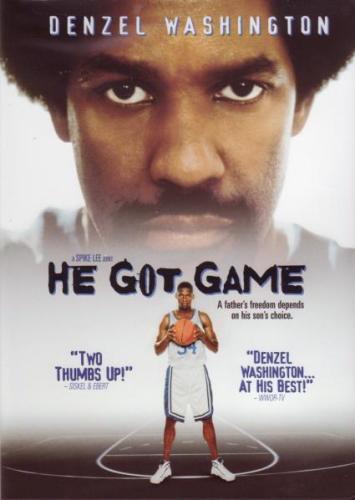
He Got Game is a 1998 sports-drama film written and directed by Spike Lee. It stars Denzel Washington as Jake Shuttlesworth, a prison inmate convicted for murdering his wife. The father of the top-ranked basketball prospect in the country, Jesus Shuttlesworth (played by NBA star Ray Allen), Jake is released on parole for a week by the state's governor in order to persuade his son to play for the governor's alma mater in exchange for a heavily-reduced prison sentence.